 From the makers of Hidden Value
What is your scrolling actually costing you?
Adjust the numbers to see how much the time you waste is actually costing you.
Start below ↓
From the makers of Hidden ValueAdjust the numbers to see how much the time you waste is actually costing you.
This is what those hours would have paid you, if you spent them on anything that earns.
Gone. Every month.
Invested figure assumes a 7% average yearly return until 65.
Sleep, work, getting ready, getting around, eating. Set your real day below and watch what is actually left.
Look how little is green. Now look how much of it is red.
That is 2h 30m a day. It does not feel like much. Stack up 30 of them.
Each block is 15 minutes you lose every month. That is a part-time job's worth of hours.
Same hours. One year. Watch how far down this list it goes.
The grey is the life you have already lived. The colours are where the rest of it goes, if today just keeps repeating.
That is years of your one life.
Based on an 80-year estimated lifespan.
Most people never see this number. Now you have.
Your focus score is the amount of free time you actually keep vs waste scrolling.
The biggest companies on earth hired literal addiction scientists to get you hooked on cheap dopamine. Here is how they did it.
Starting costs you nothing.
The reward never makes you wait.
No natural place to stop.
Hidden Value helps you fight against them.
What if you were forced to reconsider before wasting time?
Would that make it more or less likely you do?
One small nudge can change your trajectory for the next hour.
Do you think interventions that force you to stop would help you wake up from the cheap dopamine trance?
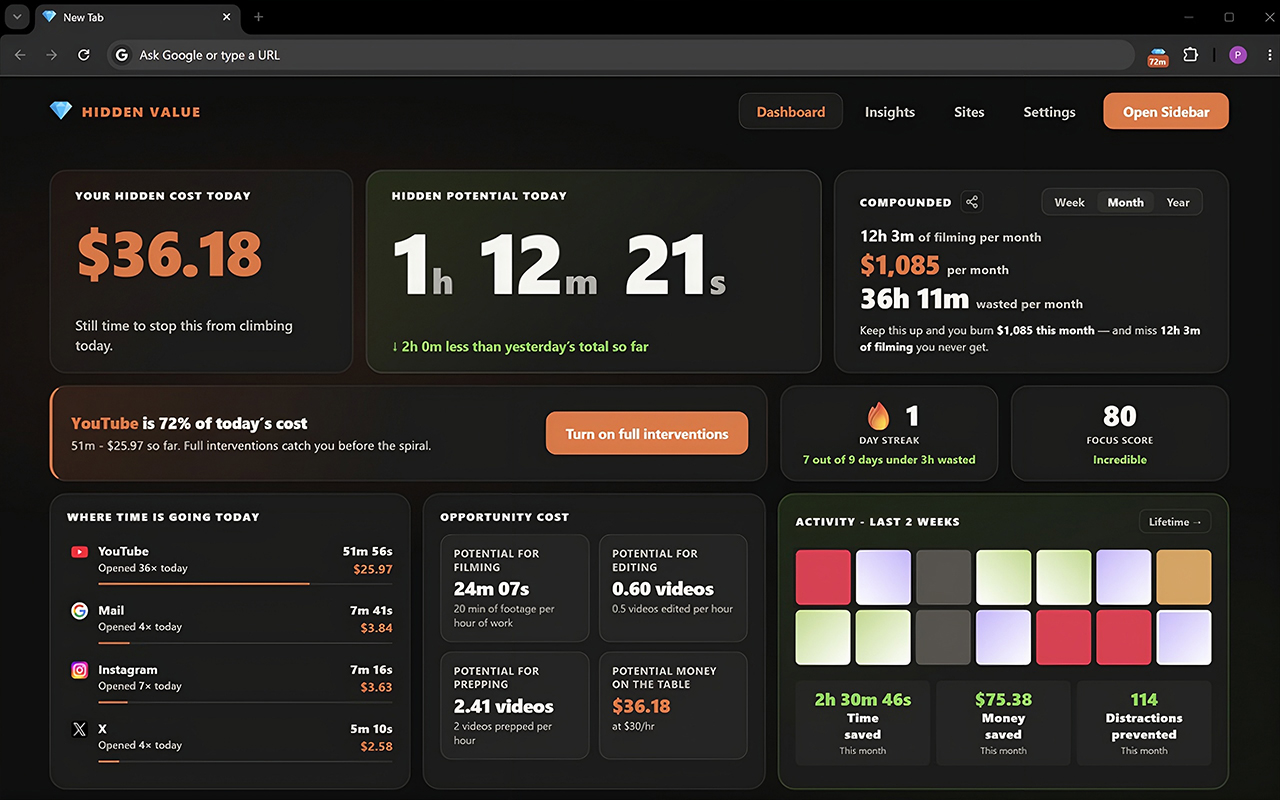
Do you think this would make you reconsider the time that gets wasted?
What if the tab closed itself and locked the cheap dopamine, so you get a chance to escape the dopamine trap?
The goal isn't to restrict access to cheap dopamine. It's to make you feel like it's not worth it in the first place.
 Get Hidden Value